
A peptide patch with no needles at all — not even microscopic ones.
Peptides usually travel by injection because skin refuses to let them through. The Panacea Sticker programme asks whether a patch can change that — using DMSO, the most storied penetration enhancer in dermatology, and pointedly without microneedles. No needles, no sharps, nothing to dispose of. Built layer by layer on the same BioDot LM9000 platform that laminates the world's rapid tests — and Panacea's own TestoStrip saliva testosterone test.
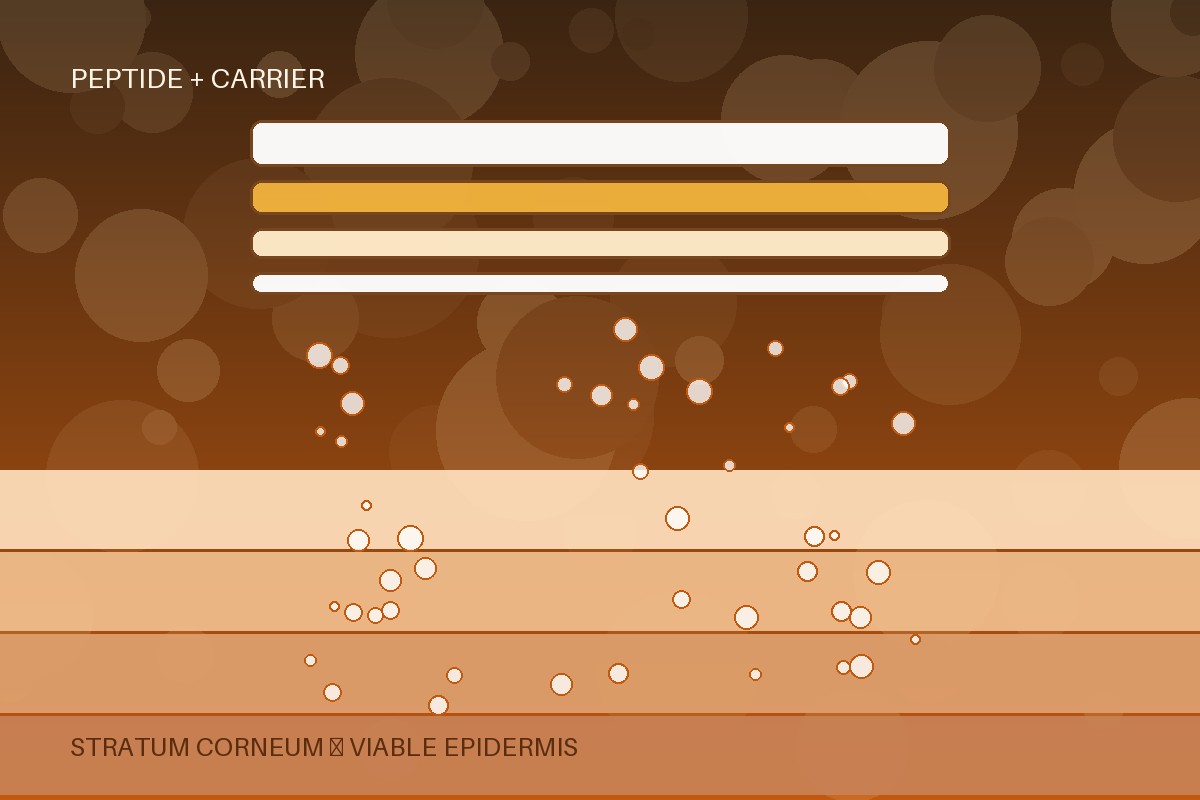
Why skin is the hardest door in drug delivery
The outermost skin layer — the stratum corneum, ten to twenty micrometres of flattened, keratin-packed cells in a lipid mortar — evolved for one job: keeping things out. It passes small, fat-friendly molecules and blocks almost everything else. A peptide is large, charged and water-loving: exactly what the barrier is built to refuse. Mark Prausnitz (Georgia Tech) and Robert Langer (MIT) laid out the problem and its possible routes in their landmark 2008 review in Nature Biotechnology — enhancement by chemistry, by electricity, by ultrasound, or by puncturing the barrier with microneedles.
The microneedle fashion
Much of the field has gone mechanical: arrays of microscopic spikes that punch through the stratum corneum. Elegant — but they are still needles: sharps to engineer, to sterilize, to dispose of, and a barrier that is broken rather than persuaded.
The chemical route
Penetration enhancers instead loosen the lipid mortar temporarily. The most famous of them all is DMSO — dimethyl sulfoxide — an aprotic solvent that carries dissolved cargo through skin with it, studied in this role since the 1960s.
Why DMSO specifically
DMSO partitions into the stratum corneum, disrupts lipid packing and can reversibly alter protein conformation in the barrier — the mechanisms reviewed across the dermatological literature (Brayton 1986; Marren 2011). It is the carrier with the longest track record in transdermal science.
The honest difficulty
Enhancers open the door partway; whether a given peptide walks through at a meaningful rate is an empirical question, peptide by peptide. That measurement programme is the Panacea Sticker.
The machine that laminates it: BioDot's LM9000
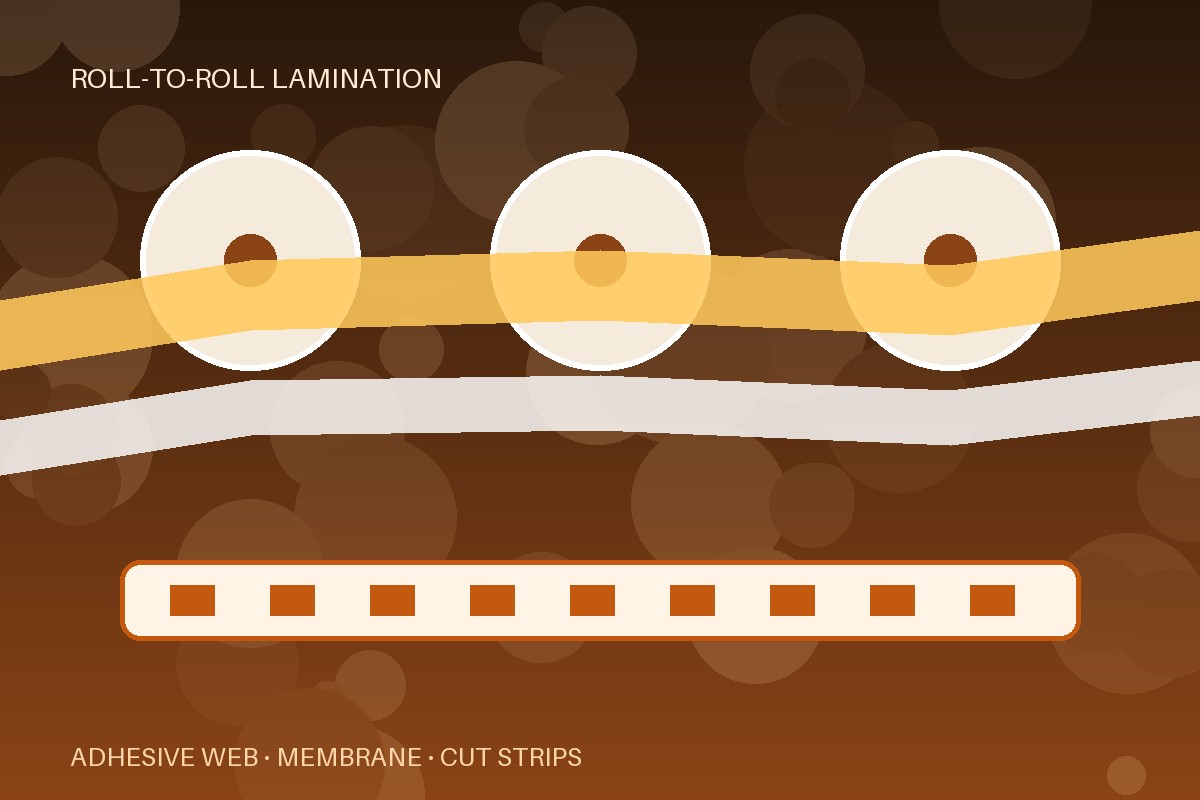
A transdermal patch is not one thing — it is a stack: backing film, reservoir or matrix layer holding the peptide and its carrier, a membrane, an adhesive. Making that stack at scale is a lamination problem, and one family of machines has defined lamination in diagnostics for three decades.
What the LM9000 is
- The LM9000 Auto Lamination System from BioDot (Irvine, California): continuous, roll-to-roll lamination of web materials onto adhesive-lined backing.
- Modular by design: membrane payout with micrometer-controlled auto-tracking, guide rollers, cutting, vision inspection, take-up reels — modules added per product.
- Built for moderate and high-volume production of layered strip and patch formats.
Why that pedigree matters
- BioDot was founded in 1994 by Dr. Thomas Tisone and Michael Surmanian to automate lateral-flow test manufacturing; its platforms (5,600+ systems in 60+ countries) help produce billions of diagnostic tests per year.
- The same lamination discipline that aligns a lateral-flow strip's sample pad, conjugate pad and membrane aligns a patch's functional layers.
- One platform, two Panacea products: the Sticker patch stack and the TestoStrip saliva test.
The Panacea position
At Panacea Bio Chem we took the unfashionable fork. The field runs toward microneedle arrays; we are pursuing the chemical route instead — a DMSO-assisted matrix patch, no needles, no sharps, manufactured as a laminated stack on the LM9000 platform. Panacea's formulation work — the same oxygen-exclusion and stabilization doctrine behind our lyophilized injectables — is applied to keep peptides intact inside the patch matrix.
This is ongoing work, and we present it as such: permeation rates are peptide-specific, the measurements are ours, and the programme publishes when there is something measured to publish. No launch date is claimed on this page.
Ongoing Panacea research · in-house measurements, labelled as such
"Everyone is drilling holes in the skin and calling it needle-free. We prefer the honest version of those words: nothing punctures anything. DMSO has been opening this door for sixty years — our job is to measure, peptide by peptide, how wide it opens. If the answer is 'not wide enough' for a given chain, we say so."
Bogdan Dicoias — Biochemist · AAC Designer · Panacea Bio Chem Ltd
TestoStrip — testosterone, measured from saliva, made on the same platform
The LM9000's second Panacea product is diagnostic rather than therapeutic. TestoStrip is a saliva-based testosterone test concept: spit, not blood. The biology supports the medium — in blood, most testosterone rides bound to proteins (SHBG, albumin); the small free fraction that enters tissues also diffuses into saliva, which is why salivary testosterone assays track the free, bioavailable hormone and have a measurement literature stretching back decades. The practical caveats are published too: collection method, handling and storage all shift results (Durdiaková and colleagues, Comenius University, 2013), and assay design matters (Goncharov and colleagues, 2006). TestoStrip is engineered with those findings on the bench, not in a footnote.
Frequently asked questions
What is the Panacea Sticker?
An ongoing Panacea research programme for transdermal peptide patches: DMSO-assisted skin permeation, deliberately without microneedles — no needles, no sharps.
Can a peptide cross skin without needles?
Skin blocks large hydrophilic molecules — that is the documented difficulty. Penetration enhancers like DMSO loosen the barrier; whether a specific peptide crosses at meaningful rates is what the programme measures.
What is the BioDot LM9000?
BioDot's LM9000 Auto Lamination System: roll-to-roll continuous lamination of layered materials onto adhesive-lined backing — the machine family behind much of the world's lateral-flow test production.
What is TestoStrip?
Panacea's saliva-based testosterone test concept, laminated on the same platform. Saliva carries the free, bioavailable testosterone fraction. More on the Questions page.
Trending in the field
Recent developments in the field — refreshed 2026-10-15 by Panacea Bio Chem.
- Skin Barrier-Informed Topical and Transdermal Drug Delivery: Excipient-Driven Strategies, Vehicle Transformation, and Translational Challenges — PubMed, 2026 Aug 26
- The Needle-Free Frontier: Redefining the Limits of Transdermal Insulin Delivery — PubMed, 2026 Aug 26
- Enhanced Transdermal Delivery of rhHAPLN1 by Soluball(®) Promotes Pericellular Matrix Stability and Keratinocyte Protection — PubMed, 2026 Jul 31
- Dermapen-mediated microchannels enable deep cutaneous delivery of liposomal and particulate model systems, with topical massage as an additional enhancer — PubMed, 2026 Oct 5




